Legal Tech • UX Evaluation
How might we make filing a civil protection order online more trauma-informed and easier to access and use for domestic violence survivors in Indiana?

When the Indiana Supreme Court launched one of the nation's first Civil Protection Order (CPO) portals in 2019, it was designed to be used independently by survivors. Five years later, court partners were seeing a consistent pattern: self-represented filers were getting stuck, abandoning the process, or relying entirely on advocates — the opposite of what the portal was built to enable. With Indiana ranking 5th nationally for domestic violence incidents, equitable access to protection orders had become a critical access-to-justice issue.
In 2024, the Indiana Supreme Court partnered with UX4Justice to evaluate and redesign the portal, bringing an interdisciplinary team together over five months to identify the barriers and provide recommendations.
Key Outcomes
UX Evaluation report submitted to the Indiana Supreme Court [link to report]
Mobile-first prototype [link to prototype]
45+ Community members engaged
Registration ease-of-use: 3.2 → 6.3 out of 7; Trauma-informed design perception: 2.6 → 5.8 out of 7
This project was intended to serve as a case study for modeling how other jurisdictions can conduct UX discoveries of their own portals and to inform the National Guidance Report [link to guidance] on best practices in CPO portal design.
Role: UX Researcher, Lead Designer, Community Engagement Lead, and Graduate Mentor
Collaborators: Innovation for Justice (i4J), National Center for State Courts (NCSC), Indiana Supreme Court
Duration: 6 months
Funder: U.S. Department of Justice’s Office on Violence Against Women
Context + Challenge
Filing a protection order is a high-stakes, emotionally demanding process. Survivors often manage trauma, safety concerns, and urgent decisions simultaneously — frequently without legal representation. Yet Indiana’s existing portal required creating an account, completing a 19-step filing process, and interpreting unfamiliar legal terminology under those exact conditions. Users were burdened with inconsistent guidance, repetitive questions, and limited contextual support, making it difficult to complete petitions with confidence. This project was an opportunity to remove those barriers and ensure that in transferring a legal system online, no additional technological barriers are created.
A Civil Protection Order (CPO) is a court order that helps protect individuals experiencing domestic or family violence, stalking, harassment, or other forms of abuse.
Between 2020 and mid-2021.
More than 40% of these petitions were submitted electronically.
The filing experience was not designed for phones, where many survivors begin.
People had to decode court terminology while navigating a high-stress process.
Support was scattered across disconnected places instead of built into the flow.
Research Process
Over five months, our interdisciplinary team worked alongside court partners to understand how survivors and self-represented litigants navigated the portal and identify opportunities to improve safety, usability, and access to justice.
Data from each research phase and the insights that surfaced were used to drive creative ideation around design solutions that better meet survivor needs. These ideas were prioritized in collaboration with Court partners, and used to drive the design of an interactive prototype.


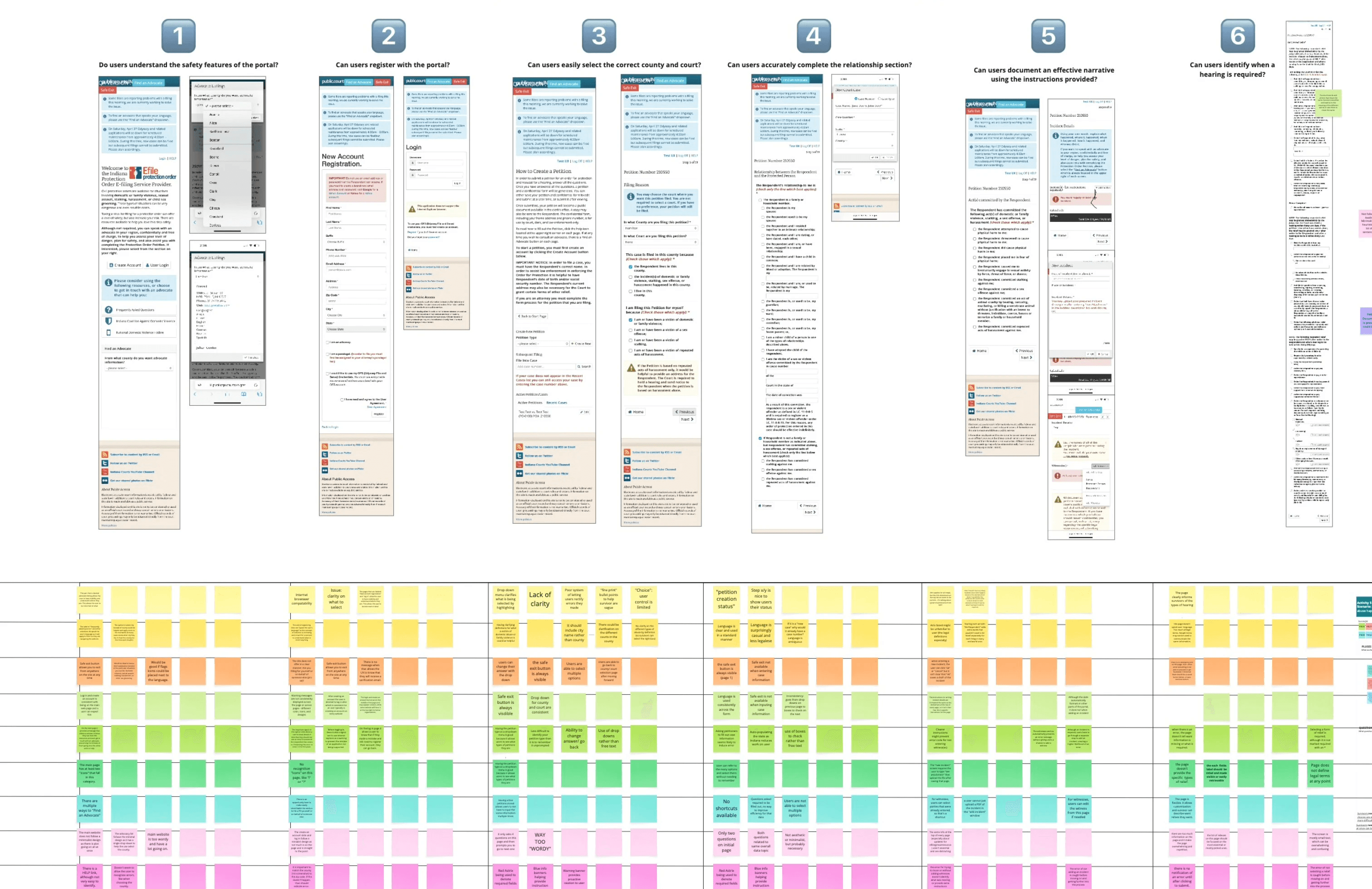
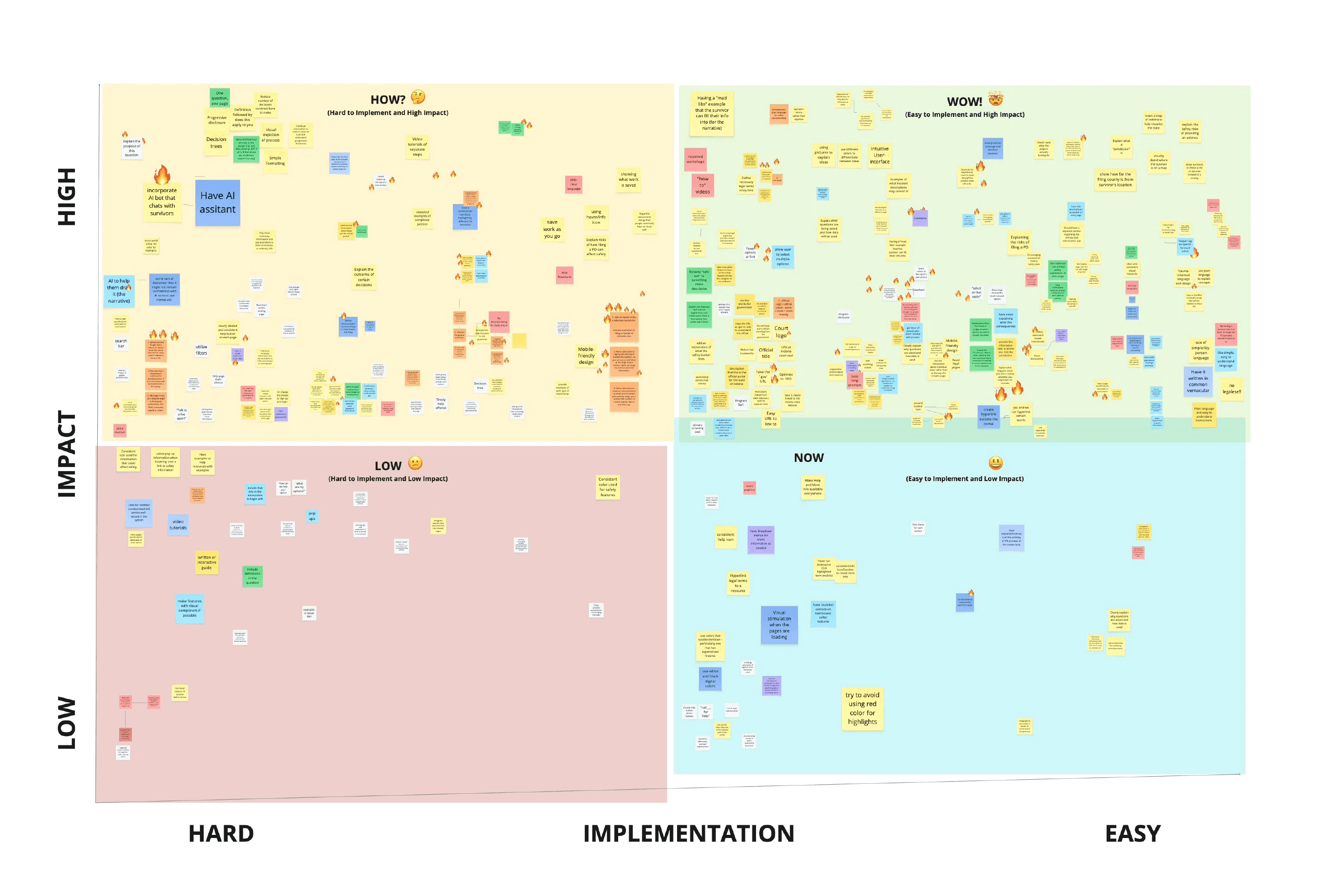
Classroom snapshots of clustering across interview data, heuristic evaluations, and idea prioritization matrix
Key Pain Points + Design Response
Research revealed that survivors were not struggling because of one single usability issue, but because the filing experience lacked guidance at critical moments. The prototype addressed these moments by transforming a fragmented legal process into a guided, supportive journey.
• Streamlining workflows to reduce confusion
• Improving language clarity for self-represented survivors
• Reducing errors that delay or prevent successful filings
Survivors encountered barriers before and during the earliest steps of filing, from a confusing registration process to inaccessible help and limited safety and privacy information. The redesign streamlined onboarding, brought guidance directly into the portal, and surfaced safety information early so survivors could begin the process with greater clarity and control.
Simpler Registration Process
A streamlined, low-friction onboarding flow with a visible entry point, simplified password setup, and clear instructions at every step.
Simpler Registration Process
Safety and privacy disclosures were made explicit, framed clearly and compassionately, so that survivors could make informed decisions before entering any personal data.
Integrated Help Resources
Contextual help was embedded directly inline so survivors could access plain-language definitions and guidance without leaving the page or losing their session.
The portal relied on complex legal language, repetitive questions, and rigid choices that did not always reflect survivors’ circumstances. The redesign simplified language, reduced repetition, introduced conditional logic, and created more flexible ways for survivors to describe their situation accurately.
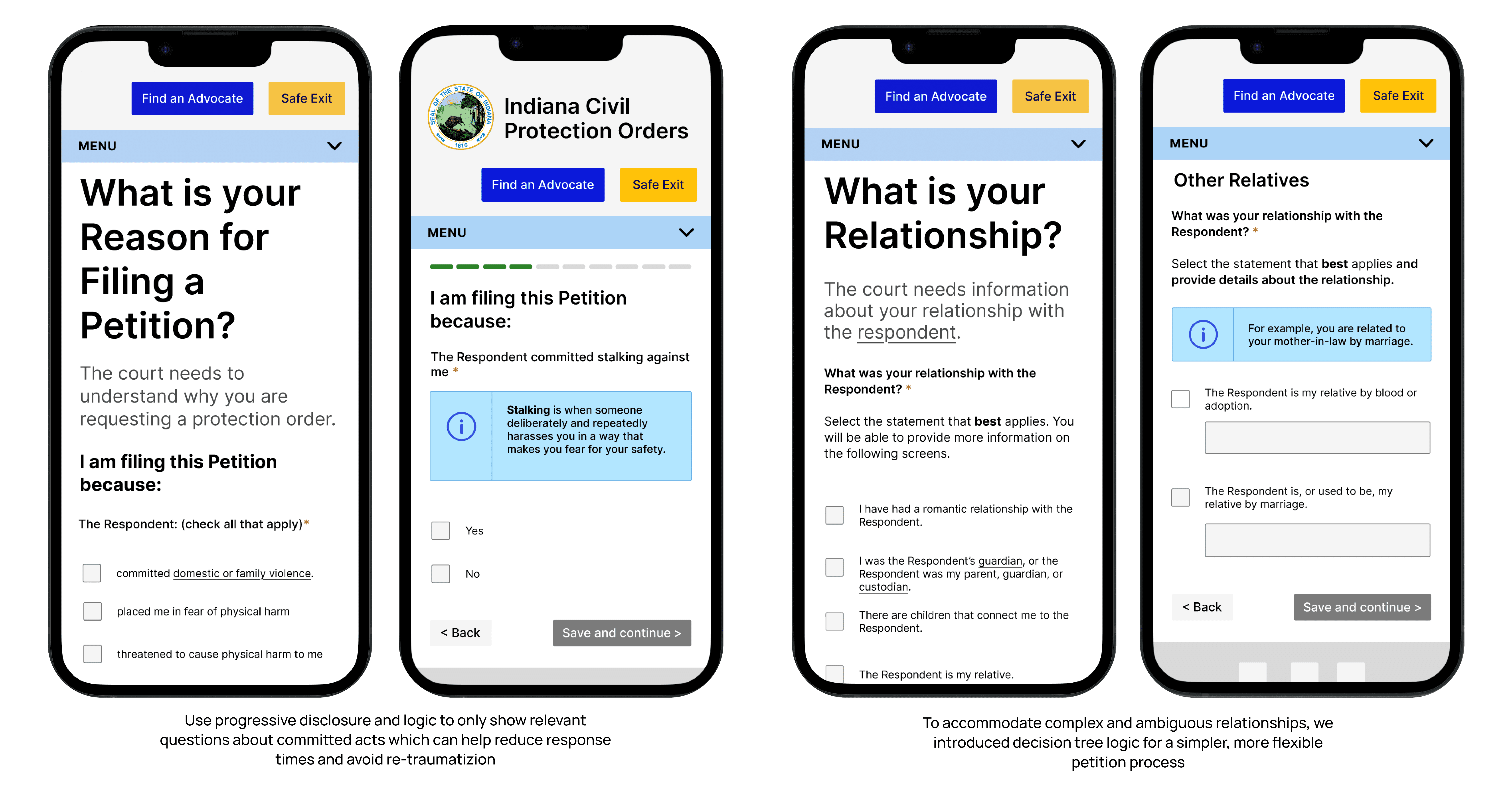
The incident narrative was one of the most difficult and emotionally taxing parts of the petition, with little guidance on what information was needed. The redesign introduced structured, trauma-informed prompts to help survivors understand what to include and provide the necessary detail without adding unnecessary emotional burden.

Helping survivors understand where to file and what happens next
Survivors lacked clear guidance about where to file and what to expect after submitting their petition, including when a hearing would be required. The redesign clarified filing decisions and made important information about hearings, remedies, and firearm requirements easier to find and understand.


Results + Impact
Necessary information and was easy to
understand and navigate
Instructions and help resources are integrated and useful to survivors.
The experience felt more supportive during a difficult moment.
This project equipped the Indiana Supreme Court with an evidence-based roadmap for a CPO portal that is more accessible, transparent, and trauma-informed. The recommendations in the full UX Evaluation Report are grounded in research, aligned with Indiana Court and community needs, and designed to make filing faster and easier for survivors working alone and for the advocates who assist them.
The methods used here are replicable: any court can apply this approach to evaluate an existing portal or build a new one from the ground up.
The impact of these improvements once implemented can be measured in the number of self-represented litigants filing alone, but more importantly in an increase in the number of approved petitions filed by survivors without the assistance of counsel, a reduction in avoidable procedural delays, and a reduction in petitions rejected due to technicalities or insufficient information.
The true societal impact of this work will be more difficult to quantify, but no less valuable: the feelings of relief, empowerment, and trust that survivors will have when they are able to address a legal problem in a time of crisis using a court technology tool that feels safe and intuitive to use is priceless.
Quick external links:
Full UX Evaluation report [link to report]
Mobile-firstprototype [link to prototype]
National Design Guidance [link to report]
CPO Portal Design Project Overview [link to lab page]